


a transcript, with clickables:
Hello. Did I do a millennial pause? Who’s to know?
I hope everyone’s well. Different setup today. I’m sitting down. I’m generally on the move, which is really my prime voice note recording time but potentially not the most enjoyable listen for you guys. Although, and here I am sounding out my process, right from the top, it’s a voice note and we all know that those are often recorded on the go. So everyone knows what they’re in for, essentially, but I thought I’d try an alternative just to see how it feels for me, mostly. Sorry. Because I think it will almost certainly, does that sentence start even make sense? I think that almost certainly, yeah. It will be better for you guys listening.
So the week in question was mostly about my sharing. It wasn’t my sharing. I was one of four works being shared, but the sharing of my work at Making Progress, which is tied to Choreodrome at The Place. So four of us were given the opportunity to share 10 minutes of what we’d been up to for 100 people, a mixture of public who just curious and wanted to see, and as The Place called them delegates, so international touring partners of The Place and general venues and organisations that might be interested in new work and artists. I had a great day. I thoroughly enjoyed. We had an option of whether to introduce the work ourselves, have it be introduced by Temi Ajose, who I believe is an Associate Artist at The Place. And or sorry, just let the work speak and have there be no introduction. And I, quelle surprise.. quelle surprise.. decided to introduce the work myself. And I really, and that happened again this week, which I’ll talk about in the next episode, but I’m having to talk about my work more and more publicly too, and like in real life, not written on the internet and having to keep it short in this wow.. in this instance was really interesting to me because what’s the most important for an audience to know or a potential partner to know and the work is personal in terms of it being my practice and ethos wrapped up in it, but it’s not autobiographical, it’s not like a tricky topic. So there is a level of detachment or lack of preciousness around it, but everything that I.. there are so there is real richness wrapped up in the work and so I think it’s all really important. So having to just find maybe three touch points to mention was quite tricky. I think I did well. I realised that however formal I try to make a presentation, I will always fall back on humour/just making it informal and chatty and that’s.. it’s just a cool find. And I think, thankfully, that I have the balance between being able to do that and kind of drop a chat down a level so that it feels safe and accessible and comfortable, but whilst retaining a seriousness, which just lends itself to me being a really unserious, serious person.
The work is built in a studio and not just rehearsed in a studio, but everything that it comes from is built from studio settings and session settings and the way that the room was set up was like a theatre, basically. It was the studios one and two downstairs as one big studio and half of that had that full-on kind of theatre seating in it. And they’d blacked out the room and we could have a lighting state so it’s as close to a theatre set up as I’ve been with the work so far and again, really interesting mostly in how that would shift things for the performers.. namely, Chaldon Williams, Lee Putman, Luana Manuka and Saskia Horton.. because there’s lights, there’s a stage, like just all the conventions that we know theatre to have are suddenly there and what does that do? And these are, you know, confident, proficient performers, but how to soften the line between performance and any expectation and wanting to deliver on any of those versus holding onto ‘I as performer can do whatever the heck I want and maybe what I want to do in that moment is impress’ and letting that be okay whilst making sure it’s known that that’s not the rule, and that’s not the task at hand so it was all kind of part of the experiment still. Thankfully, it was just 10 minutes and we were more than confident with the first three tracks of the show so compositionally, everyone was fine and you know, they all smashed it and the music slapped so really, really successful evening.
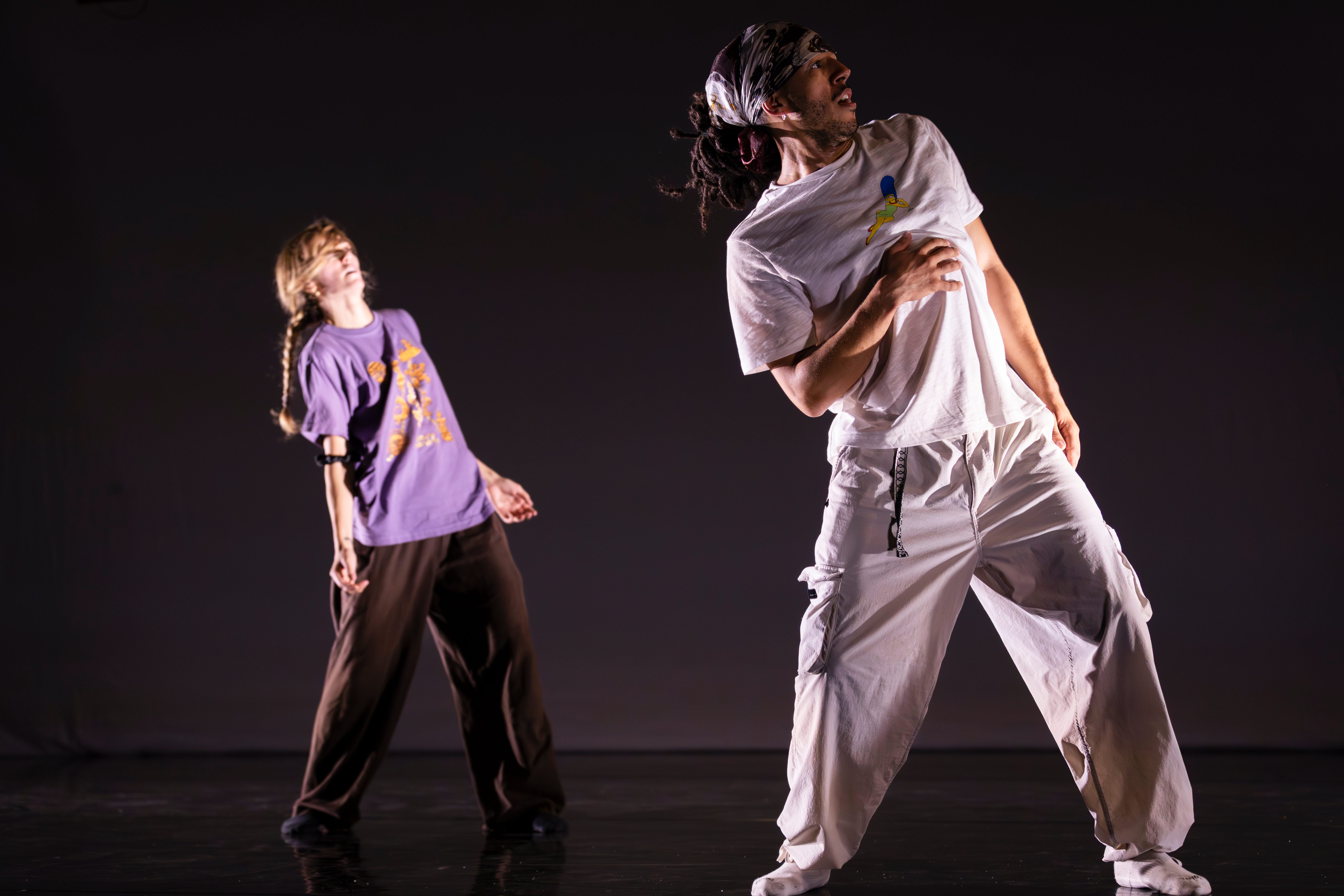
And then onto a feedback session, which Temi facilitated. So the audience was split into four to each kind of focus on one of us artists. And then there was a ‘what worked’ section, a ‘tips and tricks’, so just anything that people might think that I could add or ponder on, any books, kind of podcast, people I should look up, which was a really, really cool thing. And there was another element. There was a second in between that that I can’t oh, like ‘what resonated’, I think, or what they thought the work might have meant, I think, was the thing there. And again because I’m not too attached or like I can separate myself from it, I was open to receiving that right after the show because as Temi and I had discussed, feedback can just be a doozy. Like you just can’t, you can’t be sure that an audience member is sensitive to not just dumping on you what they think the show should be and like not getting that that might not be the time to say it or that I might not want to know that. Or, you know, it’s like you can’t expect everyone to know your boundaries around that. And so the prompts given in this session and the speed of it was really helpful for all involved as well because, you know, when a show is done, people kind of just want to go so it was really generous of everyone to hang around and give their feedback. I appreciated it a lot. Yeah, so that was the main event.
And then I think I’d like to just sound off a little bit on some agency stuff that’s happening with one of my clients and it’s got me thinking about what leaves us susceptible to taking on more than the role is. And then I thought about as performers, that’s really rare in comparison to when you are a choreographer and when you are performing generally any online comms is restricted to the logistics surrounding the gig but all the creative happenings are in rehearsal and you’d be very explicitly set a task where it would then bleed over into being creative or being asked to make up a few eights and that in that explicit ask, you are then kind of given the power.. tricky in the moment to be like ‘no, not if you’re not paying me and crediting me’ but the line is clear there, I think.
In the case of choreographers, it also happens in the room, but it’s a softer, blurrier thing where, in my experience with Lion, the Witch and the Wardrobe, I was really lucky because the director was so in everyone’s things that his direction ended at the beginning of the production number and it started again at the end of the production number so my job was to choreograph and that was it.. until it was time to remount the show and then I was being asked to reblock his remount his blocking and I was like ‘no, like, I don’t know that I don’t know that, I don’t have where the show goes at the forefront of my brain so you can pay me to know it and you can credit me as Assistant/Associate Director if you want me to do that.’ Like I just, it moves, that show moves in a pretty choreographic and musical way, but I didn’t make that blocking so am I putting it back on its feet as Choreographer like a peered Head of Department? No, I am not. But that can happen in the creation. Wow, creation of a show where around your numbers, there’s just a ‘oh and how do you think you should go into it?’ And like, and ‘where do you think we go when the number ends?’ And it’s like, ‘am I co-directing this with you?’ That hasn’t, that’s only happened to me once where, and I’m not, I’m more interested in directing now so I might be more likely to like, ‘do you want to enter a conversation where we are making this show together?’ which some directors would push back on because they’re like, ‘yeah, we are making it together.’ And it’s like ‘yeah, we are, but I’m choreographing it.’ Like, that’s dance. What are we talking about? And um I think it can kind of get away from us until it’s done and it’s sometimes only when you’re watching the show back and you’re seeing your print on it that you’re, you can notice, ‘oh, if we pulled my work out of this.. not just dance numbers, but just my input here, this show doesn’t exist’ and that can be quite a bit of pill to swallow if you are ‘just’ credited as a Choreographer or a Movement Director.
Anyhow, in this case, we’re dealing with someone that’s creative directing and as we discussed in a catch up, my client is project managing as well and just in charge of so much more than they should be, but time is of the essence, things have got to be done, and in the hands of capable people, you just, you’re on the treadmill and you just get to it and you just get it done because what is the alternative? But as we were talking about, it’s just, it’s not good enough. And now, you know, we’re just discussing, like, right, are we just grinning our teeth, gritting our teeth and bearing it? Or how are we kickstarting the conversation about handing some of this back to the producers, which.. production in terms of event management and event production, unless you are creative producers, which then just puts a bit of creative input in there, it’s logistics. And the whole point of there being producers is to offset those logistics so a creative can be creative. Oversee all the different departments, sure, but the nuts and bolts of how those things are happening, I don’t think my client should be across and they are, which tells me that the production company are dropping some balls. And then to be anecdotal one more time, it reminds me very much of when I was the agent for all the dancers on the Everybody’s Talking About Jamie film and I was naive to this because it’s the first time that I’d represented talent on a film, perhaps, definitely of that magnitude, because I was looking after more than 100 dancers and I was collating measurements, addresses, chaperones, licensing forms and things of that nature. And there was a, because I was assisting with a pop artist1 at the time as Choreographer, I was teaching quite a lot internationally that summer, quite a lot for me, not in the grand scheme of a lot and I.. that was burnout time. I was so, so stressed and it was only when I had to tell my line manager at ZooNation what I was actually doing that I looked at that list and was like, wait a minute. I don’t think.. This is production. Like there needed to be a dance producer.
By rights, an agent connects clients, connects the client being the person who needs the service to the performer or the creative that provides that service. We sort out the contract and the deal and then more often than not, remove ourselves and the creative happens between the two. That was not the case on this gig. Or, sure, I’m asking everyone for their measurements and their addresses and do they want to stay? Do they want to go home at the end of each day? Do they want somewhere to stay? All of this stuff? I can ask the question, sure, and reach out to all the people. Really, there should have been a producer cc’d into that, they’re receiving all of the information and they’re collating it and they’re moving it all forward, but I did all of that and I had a dance casting credit on the film, I think, because we did the auditions, but I didn’t have a producer credit and I dare say that I should have and I dare say that my client should have a project management credit. They’re not going to care about that. And if there’s no money to go with it then I don’t think I care about it either, but definitely learning.
Last point. I as agent, I’m not there so I only know what my client tells me and it’s really easy as creative to not fill your agent in because you’re on job and you’re just getting it done. Dripfeeding info when there isn’t a problem probably isn’t going to happen unless you are just in a constant back and forth with your agent, but at least collating your end so that as little things start to happen, so you can let your agent know all the info when a problem does occur is vital because if I don’t have all the intel, when it’s time for me to step in and actually call something out or start a conversation about something that might be going a bit off, I don’t have all the intel I can’t do that as comprehensively as I’d want to. And I think in dance circles, agents get a bad rap rightfully because lots of them are trash. But you have to give them the tools that they need to help you. And if you give them all those tools and then they’re still rubbish, then you’ve got all the answers that you need, but you can’t expect them to know everything that’s happening on the job. especially when there’s a chance that your version of events is not the producer’s version. And I think that’s where agents can be a bit garbage where they will generally.. I have experience with this, where they will take the producer’s side. It’s like, you’re not there so the fact that you’re hearing mine and theirs and without knowing which is true are just siding with them when I’m the one that pays you is a little bit.. is a little bit wild to me. A little bit wild.
I’m going off now and I had made my points. So, yeah, not too chunky a week physically, but it was a biggie and it continued to be big in the week that followed. But now, as I’m sure you can hear in my voice, I am winding down. Yeah, that was the week. I’ll be back. Have a good one and speak soon.
Big Reeeets AKA Rita Ora


